
The Real Reason that Substack is Collapsing
The Subscription Model Has Maxed Out

A few years ago Substack transformed away from being a niche newsletter-delivery system and into the main refuge for tens of thousands of journalists who were fleeing (or been kicked out) of the mainstream media. The value proposition was simple: writers could come here to build an audience that would actually pay directly for their writing. The platform recommended writers put paywalls on posts that would encourage readers to financially support their favorites. The tradeoff from other social media platforms was that the paywalls would inherently limit the reach of their best work. Nonetheless, with a thousand paid subscribers you could live the middle class dream of earning close to $100,000 a year (well, more like $80,000 after all the fees).
For a while it seemed like a reasonably good trade. No one wanted journalism to die, and the new influx of writers was doing pretty good work on the platform—albeit with lower budgets than traditional newsrooms.
But the model raised an obvious question: how many individual newsletters could the platform rationally expect readers to pay $8/month to access?
Early adopters on the platform did the best. Writers like Heather Cox Richardson and Matthew Yglesias arrived early and earned millions. But as more writers showed up the subscription revenue pie didn’t grow commensurately. Even with Substack’s discoverability mechanism (something that is missing on places like Ghost and Beehiv) it was getting more difficult to establish a real career here.
So Substack tried to solve the problem by adopting a strategy that every other tech company had already worn thin. They pivoted to adding a twitter-like function called “Notes” (which created a distinction between "“subscribers” and “followers”). Soon they incorporated video and live-streaming and encouraged posters to clip shorts into their feeds with an AI-generated clipping program.
In other words: Substack’s growth strategy was to offer almost the exact same things as every other social media network. They pushed the idea that the subscription revenues would keep the best creators on this platform and the new engagement opportunities would grow truly massive audiences. The stated plan was to make Substack the go-to-place for everything internet in a winner-take-all contest.
At first the strategy even sort of worked. A lot of new users DID join the platform and engaged with all this new free content—increasing the overall number of eyeballs that were here. These new “engaged users” helped skyrocket the VC-backed valuation , but, notably, didn’t do much to help the flood of new creators who came here to actually earn more money.
In fact, they started earning a lot less.
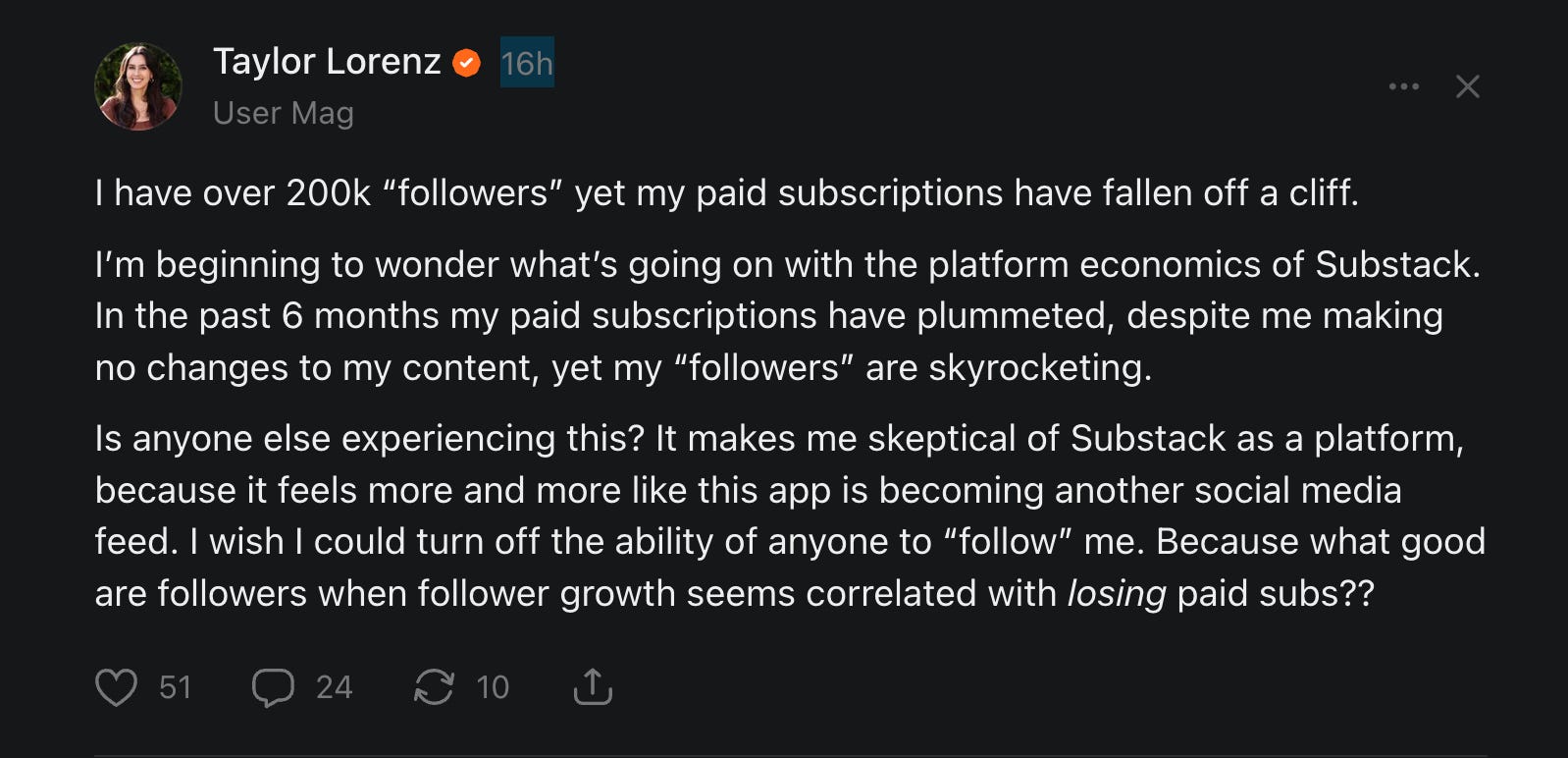
Take for instance this note from Taylor Lorenz from just yesterday.
I don’t have anywhere near Lorenz’s following, but my numbers look surprisingly similar. Here’s a peek at my own back end:
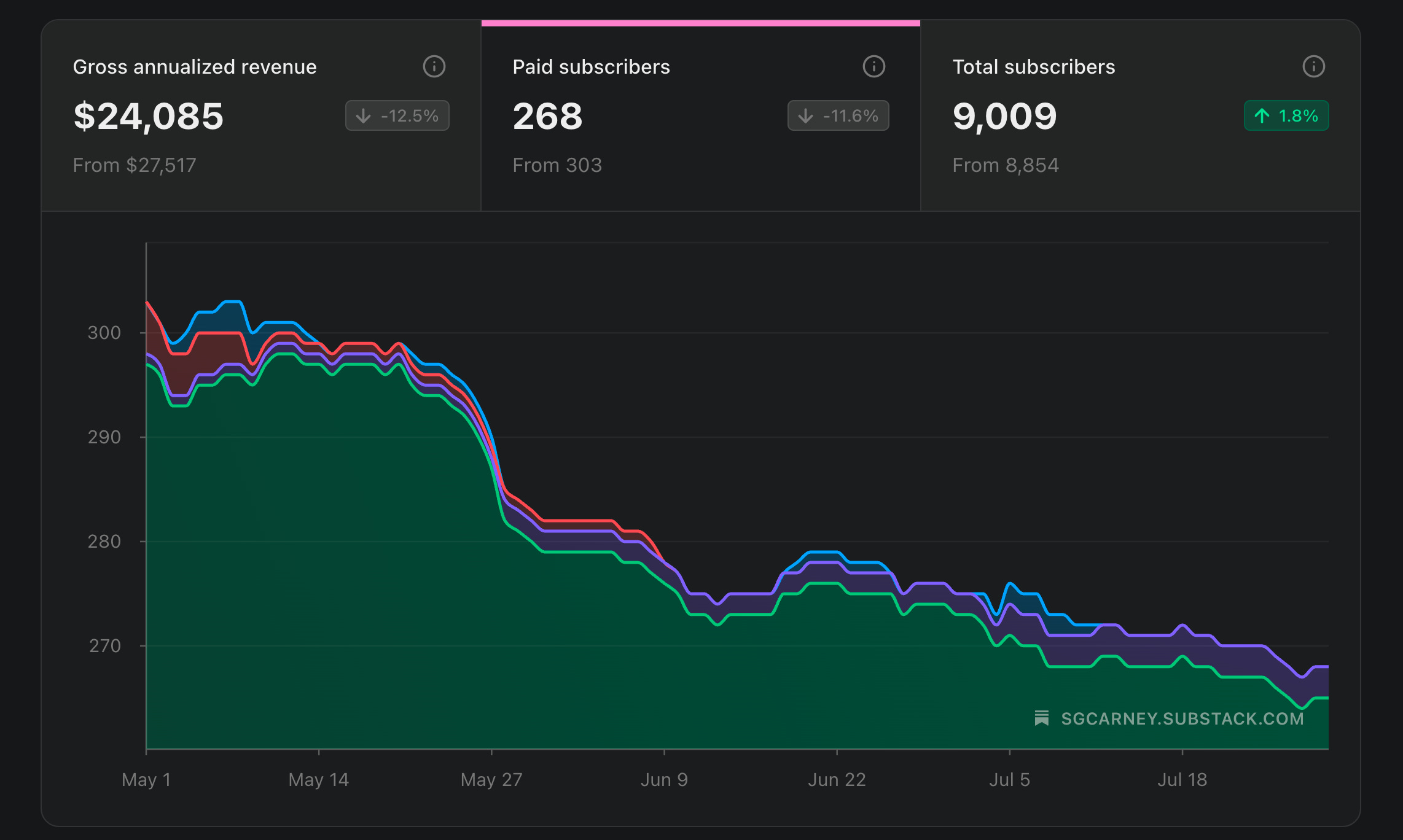
I suspect that this is a platform-wide problem and it all comes back to the central issue of subscription fatigue. As the platform promotes more and more free content, users have less and less incentive (and time) to engage with the more thoughtful higher quality content that lives behind paywalls.
On a good day my brain can only keep up with about 5 newsletters. Meanwhile my wallet is skeptical of the value of even paying for that number.
Add to that subscriptions for YouTube Premium, HBO, Netflix, The Economist, AppleTV, Amazon Prime, Hulu and so many more things, it’s just not rational to expect large audiences to subsidize the salaries of a growing number of independent writers on a monthly basis.
I can’t make a rational argument for why my own work here on Substack or on YouTube is more valuable than, say, HBO which drops whole seasons of new TV shows every week.
Without a bigger pie individual Substack creators are instead forced into direct competition with one another. The only way to grow is to pillage the paid subscribers from other creators. And this only works if you assume that when people cancel their subscriptions and then allocate that money to another writer—which I doubt happens all that frequently. Instead I think users of this platform probably pay for a few subscriptions to their favorites and, when they get tired of it, cancel and move on to scrolling an endless feed of free content.
It’s interesting to me that the higher-ups at Substack didn’t see this coming a long time ago and head it off before we reached a crisis point. One obvious thing they could have tried would be to allow creators to team up and pool their creative resources into something akin to the role previously held by newspapers.
They could have instituted some sort of curated subscription bundle that allowed me to team up with 20 or so other similar writers and share a pool of money. Perhaps readers would be open to paying $15/month to access a bunch of writers at once so that writers could share helpings of an overall larger pie. I’m not sure this would work, I assume that there would be squabbles between writers about what percentage of the bundles that they actually deserve, but I would certainly give it a go.
All of this was described very clearly by Cory Doctorow many years ago as “Enshittification.” The only real question is whether or not this platform will figure out a way to reverse course before another one comes along to try a new course.
Watching the decay of my own business on this platform has made me reassess my overall economic strategy. Fortunately I’m no stranger to adapting to ever-changing whims of the media environment. I survived staff positions, as a freelancer for mainstream magazines, through traditional book publishing, self publishing, and surviving on revenue from Patreon, Substack and YouTube. Every paradigm shift has come with advantages and disadvantages and I have faith that I will be able to ride out this wave as well.
On thing that I am coming to terms with is that while I desperately want my work to survive solely through reader support the current setup just does not pay the bills. For it to work I really would need 1000 people paying $8/month, but despite doing what I believe is consistently better work, the subscriber trends are not moving in that direction. I don’t blame my subscribers for this. I blame the macroeconomic situation.
What I have found success in has been working directly with sponsors on YouTube videos. A few years ago I was dead-set against taking outside money to support my journalism. I wanted to be truly independent and completely reader-supported. Navigating this new paradigm is tricky. There is always the temptation to lower editorial standards to court ever-more lucrative sponsors. I’ve reported on this specific problem quite a bit over the years. I am trying to do it responsibly. I have whole categories of products that I refuse to take money from—supplements, crypto schemes, banking, gambling, wellness products in general. So far I’ve found sponsors that align with me personally. Let’s hope it stays that way.
You may have heard the old saying “If you’re not paying for something you’re the product, not the customer.”
Substack offered the dream to creators that their readers really would be their customers instead of just eyeballs that they sell to third parties. It’s too bad that the architecture of the platform itself has ripped that dream away.